
Your patients who ask about BPC-157 are often the most engaged ones in your practice – the ones who’ve done independent research, arrive with printed studies, and want a clinical conversation about what the preclinical literature actually says.
They’ve done their research. They’re citing papers. And if you haven’t been staying close to the compounding peptide space this past year, the regulatory ground beneath this conversation has shifted considerably since 2023.
I’ve seen BPC-157 generate more provider questions than almost any other peptide compound – which makes sense, given the volume of preclinical research that has accumulated around it over three decades and the regulatory uncertainty providers have been navigating. What creates confusion isn’t the science. It’s the regulatory context.
The FDA’s 2023 Category 2 designation effectively shuttered legitimate 503A access to this compound. But the anticipated 2026 reclassification changes the prescribing picture meaningfully.
This guide is written for functional medicine physicians, men’s health and longevity practitioners, and sports medicine providers who want to understand what BPC-157 is at a molecular level, where the current research sits, what the regulatory history means for your practice, and how to think about sourcing quality-assured compounds when clinical access is restored. If you’re newer to the space and want a foundation on what compounded medications are and how they differ from commercially manufactured drugs, that context is worth establishing before the regulatory discussion below. We’ll also address why the grey-market “research use only” supply chain carries real patient safety exposure – a conversation your patients may not be having with anyone else.
What Is BPC-157 and Where Does It Come From?
BPC-157 stands for Body Protection Compound-157. It is a synthetic pentadecapeptide – a sequence of 15 amino acids – derived from a portion of the BPC protein found in human gastric juice.
That origin point matters clinically. The parent protein plays a role in the cytoprotective mechanisms of the gastrointestinal tract, and the isolated BPC-157 peptide fragment appears to retain and extend some of those protective signaling properties when studied in preclinical models.
The compound is not extracted from gastric fluid in any commercial or compounding process. It is synthesized – built amino acid by amino acid – which is why purity and sequencing accuracy are critical quality variables when evaluating any compounded formulation. A minor sequencing error or impurity profile from an unvalidated active pharmaceutical ingredient (API) supplier produces a different compound than what the research literature describes.
Structurally, BPC-157 is stable under physiological conditions in a way that many peptides are not. Most peptides degrade rapidly in the gastrointestinal environment, which limits oral bioavailability. BPC-157’s gastric origin appears to confer some resistance to acid degradation – a property that makes oral and sublingual delivery routes worth studying, though injectable formulations (subcutaneous and intramuscular) remain the most studied administration methods in the preclinical literature.
The compound is distinct from related research peptides like TB-500 (Thymosin Beta-4 LKKTETQ fragment) or BPC-157 acetate salt variants. When reviewing research or evaluating a compounding pharmacy’s capabilities, the specific form – BPC-157 arginine salt vs. acetate salt – and the administration route matter for accurate clinical interpretation.
BPC-157 Research Areas: What the Preclinical Literature Shows
It is important to state clearly at the outset: BPC-157 has not been approved by the FDA for any indication. The research described below is preclinical – primarily animal model studies – with a limited body of case reports and observational data in humans. Providers are solely responsible for evaluating the appropriateness of any compounded medication for individual patients based on available evidence.
With that context established, here is where the preclinical research has concentrated:
Preclinical Research Area: Gut Barrier Integrity and Mucosal Repair
The most studied research area for BPC-157 concerns gastrointestinal cytoprotection. Animal model studies have examined this compound in models of gut inflammation, ulceration, anastomosis healing, and short bowel syndrome. In these animal models, the BPC-157 peptide has been studied in connection with nitric oxide synthesis pathways, angiogenesis signaling (including VEGF-related pathways), and growth factor receptor expression in intestinal mucosal tissue. These are research-level observations of the peptide itself; they should not be attributed to any compounded formulation. The published preclinical research on BPC-157 (PubMed/NCBI) spans more than three decades of peer-reviewed literature.
Providers in functional medicine and gastroenterology-adjacent practices have shown the strongest interest in this preclinical research area. Whether any individual patient is an appropriate candidate for a compounded peptide rests solely with the prescribing provider’s clinical judgment. The preclinical signal here is reasonably consistent across multiple research teams and animal models – though the translation to human clinical outcomes requires provider judgment and careful patient selection.
Preclinical Research Area: Musculoskeletal and Connective Tissue Recovery
A second concentrated area of research examines BPC-157 in models of tendon, ligament, bone, and muscle injury. Studies have examined healing timelines for surgically severed tendons, crush injuries, and bone fracture models in rodents. In preclinical animal models, researchers have studied the BPC-157 peptide in connection with fibroblast migration and proliferation, collagen synthesis, and growth hormone receptor signaling. These observations describe research-level findings about the peptide and are not properties of any compounded formulation.
Sports medicine and longevity practitioners frequently field patient questions about peptides in this preclinical research area. Clinical appropriateness for any individual patient is determined solely by the prescribing provider. These are often the same patients asking about other longevity-adjacent injectable compounds like NAD+ therapy, which speaks to the broader interest in compounded injectables among this patient population.
The research base here is substantial in animal models. The absence of human clinical trial data is a genuine limitation that informed providers need to communicate clearly to patients.
Preclinical Research Area: Inflammation and Systemic Signaling
A third research area concerns BPC-157 and systemic inflammatory signaling. Preclinical studies have examined BPC-157 in models of organ protection, neuroinflammation, and cardiovascular tissue following induced injury. The mechanisms proposed across these studies often involve nitric oxide pathway modulation and interactions with the dopaminergic and serotonergic systems at the central nervous system level in animal models.
This research thread is less directly actionable for most prescribers but contributes to the broader research interest in BPC-157, where preclinical observations span multiple physiological systems. That breadth drives patient curiosity and also makes careful clinical translation challenging.
Across all three research areas, a consistent theme emerges: the preclinical signal is substantial enough that BPC-157 has attracted serious academic attention over roughly three decades of research. The translation gap to human clinical data is real, and it is the honest framing every provider should bring to patient conversations about this compound.
The 2023 FDA Ban on BPC-157: What Category 2 Meant for Your Practice
In 2023, the FDA finalized its review of bulk drug substances used in compounding (FDA.gov) and placed BPC-157 on the Category 2 list – substances that the agency determined may present significant safety risks or for which the available evidence does not support use in compounding. This designation effectively prohibited 503A compounding pharmacies from preparing BPC-157 for individual patient prescriptions.
The decision was controversial in the compounding and functional medicine communities, and providers had legitimate questions about the evidentiary basis for the designation. The FDA’s reasoning centered on the absence of adequate human safety data, not on documented evidence of widespread adverse events. That distinction matters for how you interpret the regulatory history – and for how you communicate with patients who are frustrated by the access restriction.
What the 2023 designation did in practice:
- Closed legitimate 503A access: PCAB-accredited compounding pharmacies operating under proper 503A compounding standards could no longer prepare BPC-157 for individual patient prescriptions, regardless of the prescriber’s clinical rationale.
- Did not eliminate patient demand: Patients who had been using compounded BPC-157 or who discovered it through research did not stop asking for it. Many turned to unregulated online sources – which created the grey-market access problem described in the next section.
- Created prescriber liability exposure: Providers who attempted to work around the restriction through non-pharmacy channels or who counseled patients toward unregulated sources took on meaningful professional and legal risk.
- Left the research pipeline intact: The Category 2 designation did not prohibit research or clinical investigation. Academic and clinical interest in BPC-157 continued, which contributed to the subsequent reclassification review process.
The practical effect for your practice was straightforward: between the 2023 designation and the anticipated 2026 reclassification, legitimate prescribing access was off the table through compliant 503A channels. Providers who wanted to discuss BPC-157 with patients were in the position of explaining a regulatory gap rather than offering a prescribing pathway.
The 2026 BPC-157 Reclassification: What Category 1 Status Means
The anticipated 2026 reclassification of BPC-157 from Category 2 to Category 1 status represents a meaningful change in the regulatory framework for prescribers. Category 1 designation indicates that the FDA has determined the bulk drug substance may be used in compounding – meaning the compound can again be prepared by licensed 503A compounding pharmacies based on individual patient prescriptions from licensed providers.
This is not FDA approval. That distinction requires repeating.
Category 1 status means the substance is permissible in compounding – not that the FDA has reviewed and approved a specific compounded formulation for any indication. The compounded product still carries the standard status of all 503A compounds: not reviewed by the FDA for safety or effectiveness, prepared based on a prescription for an individual patient, and subject to the quality standards of the compounding pharmacy’s own processes and accreditation.
What the anticipated Category 1 reclassification means for prescribers in practice:
- Prescription access through licensed 503A pharmacies is restored: PCAB-accredited 503A pharmacies can once again prepare BPC-157 formulations based on individual patient prescriptions, provided the pharmacy’s quality systems and ingredient sourcing meet applicable standards.
- Provider responsibility for clinical appropriateness remains unchanged: The reclassification does not change the prescriber’s responsibility to evaluate whether compounded BPC-157 is appropriate for a specific patient based on available evidence, the patient’s clinical history, and the absence of a suitable FDA-approved alternative.
- Sourcing and quality accountability become central: With legitimate access restored, the quality of the compound – determined by the pharmacy’s API sourcing, testing protocols, and compounding standards – becomes the variable that most directly affects patient safety. This is where pharmacy selection matters significantly.
- Documentation and clinical rationale are more important than ever: Given the regulatory history of this compound, maintaining thorough documentation of clinical rationale, patient informed consent, and prescription records is appropriate practice hygiene.
Providers who have been waiting for this reclassification should also be aware that the restoration of access does not mean all compounding pharmacies are equally positioned to provide quality-assured BPC-157. The gap between what a compliant PCAB-accredited pharmacy produces and what the grey market has been distributing is substantial – and that gap has patient safety implications your patients may not fully appreciate.
Why Grey-Market BPC-157 Sourcing Creates Real Patient Safety Risks
During the Category 2 restriction period – and continuing even as legitimate access returns – patients have been obtaining BPC-157 labeled as “research use only” or “not for human use” from unregulated online vendors. Some providers have encountered patients who are already using these products and presenting for clinical guidance. Understanding the specific risks in this supply chain matters for how you counsel those patients.
The “research use only” designation is not a regulatory category that provides meaningful consumer protection. It is a legal posture that vendors use to sell compounds for which they have no legitimate distribution pathway.
For providers who want a fuller picture of how compounding pharmacies are actually regulated – and why that distinction matters when evaluating a pharmacy partner – that background is useful context for these patient conversations. The products themselves may be sourced from manufacturing operations with no oversight, no validated testing protocols, and no accountability for what is actually in the vial or capsule.
The specific patient safety risks in this supply chain include:
These risks describe gaps in the unregulated supply chain. They are not eliminated in any compounding context – but in a PCAB-accredited 503A pathway, they are addressed through documented quality controls that the prescribing provider can verify.
- Sequencing inaccuracy: Peptide synthesis requires exact amino acid sequencing. Without independent third-party verification, there is no reliable way to confirm that a “research use only” product contains the correct BPC-157 sequence rather than a related compound, a truncated sequence, or a completely different peptide.
- Contamination with endotoxins and heavy metals: Legitimate pharmaceutical-grade compounding requires endotoxin testing for injectable formulations. Unregulated vendors have no such requirement. Endotoxin contamination in injectable products produces pyrogenic reactions that can be serious.
- Incorrect concentration and dosing: Without validated assay testing, the stated concentration of a grey-market peptide product may bear no relationship to actual content. Patients dosing based on stated concentration may be dramatically over- or under-dosing.
- Sterility failures: Injectable peptides require sterile compounding in appropriate cleanroom environments. Products assembled outside of USP 797-compliant sterile compounding facilities carry infection risk from microbial contamination.
- No chain of custody or ingredient traceability: A PCAB-accredited compounding pharmacy can trace the API in any batch back to the FDA-registered supplier and provide certificates of analysis. Grey-market vendors cannot and will not provide equivalent documentation.
| Quality Factor | Grey-Market “Research Use Only” | Licensed 503A PCAB-Accredited Pharmacy |
|---|---|---|
| API Sourcing | Unknown / Unverified | FDA-Registered Suppliers Only |
| Sequence Verification | None Required | Independent Lab Verification |
| Endotoxin Testing | Not Performed | Required Per USP 797 |
| Sterile Compounding Environment | Unknown / Uncontrolled | ISO-7 Cleanroom + ISO-5 Hoods |
| Concentration Verification | Stated Only / Unverified | Assay-Confirmed Per Batch |
| Chain of Custody / Lot Tracing | Not Available | Full Batch Documentation |
| Prescriber Liability | High Exposure | Protected Through Compliant Pathway |
The contrast above reflects the difference between a regulated 503A supply chain with documented quality controls and an unregulated one without them – not between an inherently safe compound and an unsafe one. Both contexts involve a peptide with inherent clinical considerations the prescribing provider must weigh. Only the regulated pathway gives the provider verifiable accountability at every step.
When a patient tells you they’ve been using BPC-157 from an online source, these are the specific questions worth asking: Do you have a certificate of analysis from an independent lab? Do you know whether the product was tested for endotoxins? Is the concentration verified?
Most patients have not thought through the supply chain at this level – and that conversation is part of the provider’s role when discussing compounded peptides. For broader guidance on educating patients about compounded medications and the questions worth building into those discussions, that resource covers the framework in detail.
How to Compound BPC-157 Through a Licensed 503A Pharmacy
When Category 1 access is restored, the prescribing pathway through a licensed 503A pharmacy looks substantially different from anything the grey market provides. Understanding the process helps providers set accurate expectations with patients – and helps distinguish between pharmacies that are simply licensed and pharmacies that are operating at a genuinely high-quality standard.
Here is what the compounding process involves for a peptide like BPC-157 at a quality-first 503A pharmacy:
API Sourcing from FDA-Registered Suppliers
The bulk drug substance used in compounding must come from an FDA-registered API supplier. This is a baseline 503A requirement, and it is the first quality gate that separates licensed compounding from unregulated production. A reputable compounding pharmacy maintains documented supplier relationships and can provide the FDA registration status of the API source on request.
Third-Party Identity and Purity Testing
A PCAB-accredited pharmacy does not simply accept a supplier’s certificate of analysis at face value. Independent third-party testing – conducted by an accredited analytical laboratory – verifies that the API received matches the expected identity, purity profile, and potency specifications before it enters the compounding process.
For a peptide compound, this means sequence verification and purity assay. For injectable formulations, it also means endotoxin testing and sterility confirmation. MediVera’s commitment to third-party pharmaceutical testing standards details the scope of that investment and what it covers at the batch level.
This testing investment is significant. It represents a meaningful operational cost that legitimate compounding pharmacies absorb because it is the foundation of product quality – and patient safety.
Grey-market vendors do not make this investment. They cannot provide equivalent documentation because they have not done equivalent testing.
USP 797-Compliant Sterile Compounding Environments
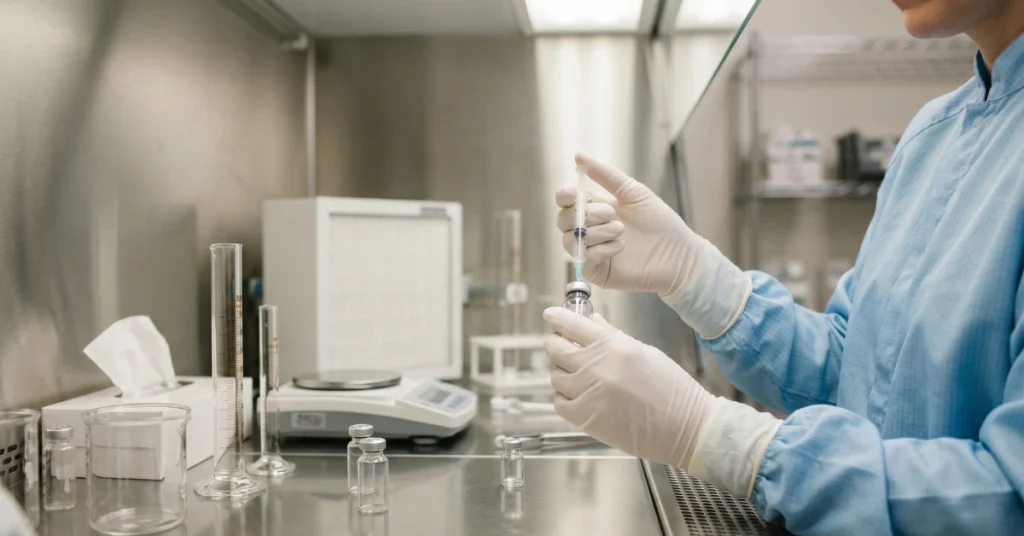
Injectable peptide formulations require sterile compounding under USP 797 standards. This means ISO-classified cleanroom environments, validated air quality monitoring, gowning protocols, and ongoing environmental testing. The cleanroom environment for sterile compounding is not an aspirational standard – it is a baseline requirement for any injectable compound to meet the safety expectations of the prescribing provider.
USP 797 compliance is verified through PCAB accreditation – and dual accreditation in both sterile and non-sterile compounding, held by fewer than 1% of compounding pharmacies nationally, reflects a particularly thorough commitment to these standards.
Batch Testing and Release Documentation
Before any lot of compounded BPC-157 is released for dispensing, a compliant pharmacy conducts batch-level quality testing and maintains release documentation. If a provider or patient ever needs to audit a specific lot – which is particularly relevant for any adverse event investigation – this documentation chain must be intact and retrievable.
Proper Formulation and Labeled Concentration
The prescribing provider specifies the compound, concentration, delivery format, and dosing instructions. The pharmacy prepares exactly what was prescribed, with labeled concentration verified against assay results rather than assumed from ingredient weights alone. This is how a provider can have clinical confidence that the patient is receiving what was prescribed.
Why BPC-157 Pharmacy Selection Matters: MediVera’s Quality Standards
When BPC-157 compounding access is restored through the anticipated Category 1 reclassification, not every compounding pharmacy will be equally prepared to provide the quality standard that this compound warrants. MediVera Compounding Pharmacy is positioning as a quality-first partner for providers who want to prescribe peptide compounds with documented accountability throughout the production process.
Here is what that means in practice:
- Dual PCAB Accreditation in sterile and non-sterile compounding: Fewer than 1% of compounding pharmacies in the United States hold PCAB accreditation in both sterile and non-sterile categories. The American Medical Association recommends that prescribers work exclusively with PCAB-accredited pharmacies. MediVera holds both – a distinction that reflects the depth of quality investment across the full compounding operation. Review the full scope of MediVera’s quality and compliance standards for the complete picture of what that accreditation covers.
- $60,000+ monthly third-party testing investment: MediVera’s testing investment is documented and ongoing – not a marketing claim, but an operational commitment that covers API identity verification, potency assay, endotoxin testing, and sterility confirmation for injectable formulations.
- State-of-the-art 56,000 sq ft facility with ISO-7 cleanrooms and ISO-5 hoods: The sterile compounding environment at MediVera’s Troy, Michigan facility opened in March 2025 and is designed to meet and exceed USP 797 requirements for sterile pharmaceutical compounding.
- Nine dedicated compounding pharmacists on staff: The clinical depth in MediVera’s pharmacy team means that prescribers have access to pharmacist consultation on formulation, dosing, and delivery method questions – not just order processing.
- Licensed in 43+ states with ongoing expansion: For telehealth providers or multi-state practices, MediVera’s nationwide licensing footprint means that prescription fulfillment can reach patients regardless of geography.
- 27 years of compounding pharmacy operations: Founded in 1999, MediVera brings institutional experience in quality-assured compounding that newer market entrants simply cannot replicate. The operational systems, supplier relationships, and quality culture are built over decades – not assembled quickly to meet market demand.
- API sourced exclusively from FDA-registered suppliers: No shortcuts in the supply chain. Every ingredient entering the compounding process at MediVera traces back to an FDA-registered source with documentation available on request.
For providers who are preparing to add BPC-157 to their prescribing toolkit when access is restored, establishing a relationship with a PCAB-accredited 503A pharmacy now – rather than scrambling when reclassification takes effect – is the practical way to be ready to serve patients without delay.
To learn more about partnering with MediVera for peptide compounding, including BPC-157 when it becomes available under Category 1 status, reach out to our provider partnership team through the Impressed Advantage by MediVera provider portal. Our account management team works directly with functional medicine, men’s health, and longevity practitioners to support efficient prescription fulfillment and clinical education resources.
Frequently Asked Questions About BPC-157 Compounding
What is BPC-157 and what is it derived from?
BPC-157 is a synthetic pentadecapeptide – a 15-amino acid sequence – derived from a protein fragment found in human gastric juice. It is built through laboratory synthesis rather than extracted from biological sources.
The peptide has been examined in preclinical animal models across several research areas. It is not FDA-approved for any indication, and any clinical decision-making rests solely with the prescribing provider.
Why was BPC-157 placed on the FDA’s Category 2 list in 2023?
The FDA’s 2023 Category 2 designation for BPC-157 was based primarily on the absence of adequate human safety data rather than documented widespread adverse events. The agency determined that without adequate clinical evidence, the compound presented safety risks that could not be adequately characterized. This designation prohibited 503A compounding pharmacies from preparing BPC-157 for individual patient prescriptions during the restriction period.
What does the anticipated 2026 Category 1 reclassification mean for prescribers?
A Category 1 designation would restore the ability of licensed 503A compounding pharmacies to prepare BPC-157 for individual patient prescriptions. It does not represent FDA approval of any specific formulation.
Providers would still be responsible for determining clinical appropriateness for each patient, documenting rationale, and selecting a PCAB-accredited pharmacy partner. The reclassification restores the legitimate prescribing pathway – it does not change the regulatory status of the compound itself.
Is it safe for patients to use “research use only” BPC-157 from online sources?
Grey-market “research use only” products carry significant patient safety risks that providers should discuss with any patient who has been using them. These risks include sequencing inaccuracy, endotoxin contamination in injectable formulations, unverified concentration levels, sterility failures from non-compliant production environments, and no traceable chain of custody.
These are not theoretical concerns – they are direct consequences of the absence of pharmaceutical-grade quality controls. Patients should not use these products, and providers who counsel otherwise take on meaningful liability exposure.
What is the difference between a PCAB-accredited pharmacy and a standard licensed compounding pharmacy?
PCAB (Pharmacy Compounding Accreditation Board) accreditation requires pharmacies to meet stringent standards for quality systems, testing protocols, facility conditions, and operational practices – standards that go well beyond basic state pharmacy licensure.
The American Medical Association recommends that prescribers work only with PCAB-accredited compounding pharmacies. Fewer than 1% of compounding pharmacies hold PCAB accreditation in sterile compounding. Dual accreditation in both sterile and non-sterile compounding is even less common.
What formulations of BPC-157 are typically available through compounding pharmacies?
When prepared by a licensed 503A compounding pharmacy, BPC-157 is typically available in injectable subcutaneous formulations, oral capsules, and sublingual formats. The specific formulation appropriate for a given patient depends on the provider’s clinical rationale, the compound’s bioavailability characteristics in each format, and the patient’s practical circumstances. A pharmacist at a quality-accredited compounding pharmacy can provide formulation consultation for prescribing providers.
How should providers document prescriptions for compounded BPC-157?
Documentation best practices for compounded BPC-157 include a thorough clinical rationale explaining why a compounded medication is appropriate for this specific patient, documentation of the absence of a suitable FDA-approved alternative, informed consent language that accurately conveys the compound’s status as a non-FDA-approved product, and records of the specific pharmacy used and lot tracking information when available. Given this compound’s regulatory history, thorough documentation is appropriate professional hygiene regardless of when reclassification takes effect.
How should providers approach prescribing decisions for BPC-157 in different patient contexts?
Compounded medications are prescribed for individual patients based on individualized clinical evaluation by the prescribing provider. The provider is solely responsible for determining clinical appropriateness based on the patient’s specific circumstances and the available evidence for the proposed application. Providers should separate discussions of potential research applications from prescribing decisions, and should avoid any framing that positions the compound as treating or curing specific diseases or conditions.
What should I look for when selecting a compounding pharmacy for peptide compounds?
Key selection criteria for a compounding pharmacy partner for peptide compounds include PCAB accreditation in sterile compounding, documented third-party testing investment (API identity, potency assay, endotoxin, sterility), ISO-classified cleanroom environments meeting USP 797 standards, FDA-registered API sourcing, and the pharmacist depth to support clinical consultation. State licensing across the geographies you serve is also a practical requirement for multi-state or telehealth practices.
When will compounding access for BPC-157 actually be restored?
The anticipated 2026 reclassification is based on the FDA’s review process and the clinical and safety data available through that review. Providers should monitor official FDA communications and compounding industry updates for confirmed reclassification announcements. A quality compounding pharmacy partner will communicate directly with prescribing providers when compliant BPC-157 compounding access is formally restored – and will be operationally ready to fulfill prescriptions when that moment arrives.
BPC-157 Prescriber Readiness Checklist
- Confirmed Category 1 reclassification status with FDA or pharmacy partner before prescribing
- Selected a PCAB-accredited 503A pharmacy with documented sterile compounding capabilities
- Verified pharmacy uses FDA-registered API suppliers and provides third-party test documentation
- Documented individualized clinical rationale for each patient prescription
- Obtained informed consent acknowledging the compound is not FDA-approved
- Confirmed no suitable FDA-approved commercial alternative exists for the patient
- Established lot tracking records for any compounded BPC-157 prescriptions
- Counseled patients away from grey-market “research use only” sources
Preparing Your Practice for Restored BPC-157 Access
The BPC-157 regulatory story is not finished. The 2023 Category 2 designation was a pause – not a permanent closure – for providers who have been tracking this compound’s research trajectory with genuine clinical interest. The anticipated 2026 reclassification restores the legitimate prescribing pathway that functional medicine, longevity, and men’s health practitioners have been waiting for.
What that restoration requires from your practice is not complicated. It requires a PCAB-accredited pharmacy partner with documented third-party testing, FDA-registered API sourcing, and sterile compounding infrastructure operating under USP 797 standards – with batch-level documentation available for every lot prepared.
It requires your own clinical framework for patient selection, informed consent, and documentation. And it requires clear communication with patients about what this compound is – a preclinically studied peptide available through a licensed compounding pharmacy based on an individualized prescription – and what it is not.
MediVera Compounding Pharmacy has built the quality infrastructure, state licensing footprint, and clinical support model to be that partner. The Impressed Advantage by MediVera telehealth pharmacy fulfillment model is designed specifically for providers who need a pharmacy partner that keeps pace with their clinical approach – fast fulfillment, dedicated account management, and pharmacist consultation resources when you need them.
When BPC-157 access is formally restored, your patients who have been asking about it deserve access through a supply chain you can stand behind. Start that conversation with us now.
Contact our provider partnership team through the MediVera provider portal or visit our dedicated provider partnership page to learn more about compounding capabilities, peptide formulary availability, and how the Impressed Advantage model supports your practice workflow.
This article is for informational purposes only and is not medical advice. Always consult a healthcare professional before starting any treatment. Compounded medications referenced are not reviewed by the FDA for safety or effectiveness and are prepared by prescription for individual patients. Providers are solely responsible for determining their appropriateness. BPC-157’s regulatory status under 503A compounding may be subject to change; prescribers should verify current FDA guidance before prescribing. Any reference to clinical or research use is for informational purposes only.
