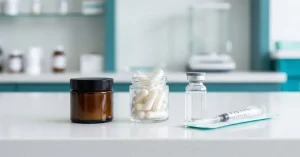

A Trimix injection delivers three drugs at once. Alprostadil, papaverine, and phentolamine all act on smooth muscle and blood vessels in penile tissue. The dose goes into the side of the shaft, and a compounding pharmacy prepares it against one prescriber’s order for one patient.
Only one of those three drugs carries FDA approval for this use. That single fact governs most of what follows, including the dosing figures further down this page. Every onset window and dosing figure published elsewhere online should be read against it too.
What Trimix Is, What Goes Into It, and Why It Isn’t FDA-Approved
Trimix is a formula rather than a branded product, which is part of why no two descriptions of it online quite agree. The three drugs in it reach the same endpoint by three separate routes. Whether a multi-agent formula suits any individual patient is a determination the prescriber makes.
| Ingredient | Drug class | What it does in penile tissue |
|---|---|---|
| Alprostadil (prostaglandin E1) | Prostaglandin | Relaxes smooth muscle in the penile arteries through the cAMP pathway |
| Papaverine | Vasodilator | Relaxes smooth muscle in blood vessel walls |
| Phentolamine | Alpha-blocker | Blocks the alpha-adrenergic receptors that narrow blood vessels |
Those mechanisms belong to the drugs themselves, not to any particular compounded preparation. The dose goes straight into the tissue and skips the nerve signaling that oral tablets depend on. So injection therapy can still work after tablets stop, and blood flow changes while tissue size stays where it was.
Of the three drugs, only alprostadil carries FDA approval for injection into the penis. Papaverine and phentolamine are approved for other uses, neither one for erectile dysfunction, and the combination has no approval at all. The AUA’s 2018 erectile dysfunction guideline states the position plainly.
Injectable non-prostaglandin agents “have been used to successfully manage ED for decades,” the guideline records. None of them are formally FDA-approved for that use. Decades of clinical use and no approval are both true at once, and neither one cancels the other out.
Compounded drugs are not FDA-approved as a category. Per the FDA’s compounding questions and answers, no agency reviews their safety, effectiveness, or quality before a patient receives one. The category exists for people whose needs an approved product cannot meet.
One warning on the alprostadil label lands directly on this formula. No clinical study has established the safety of mixing alprostadil with other vasoactive drugs inside the penis. The risk of a prolonged erection climbs, and blood pressure can drop.
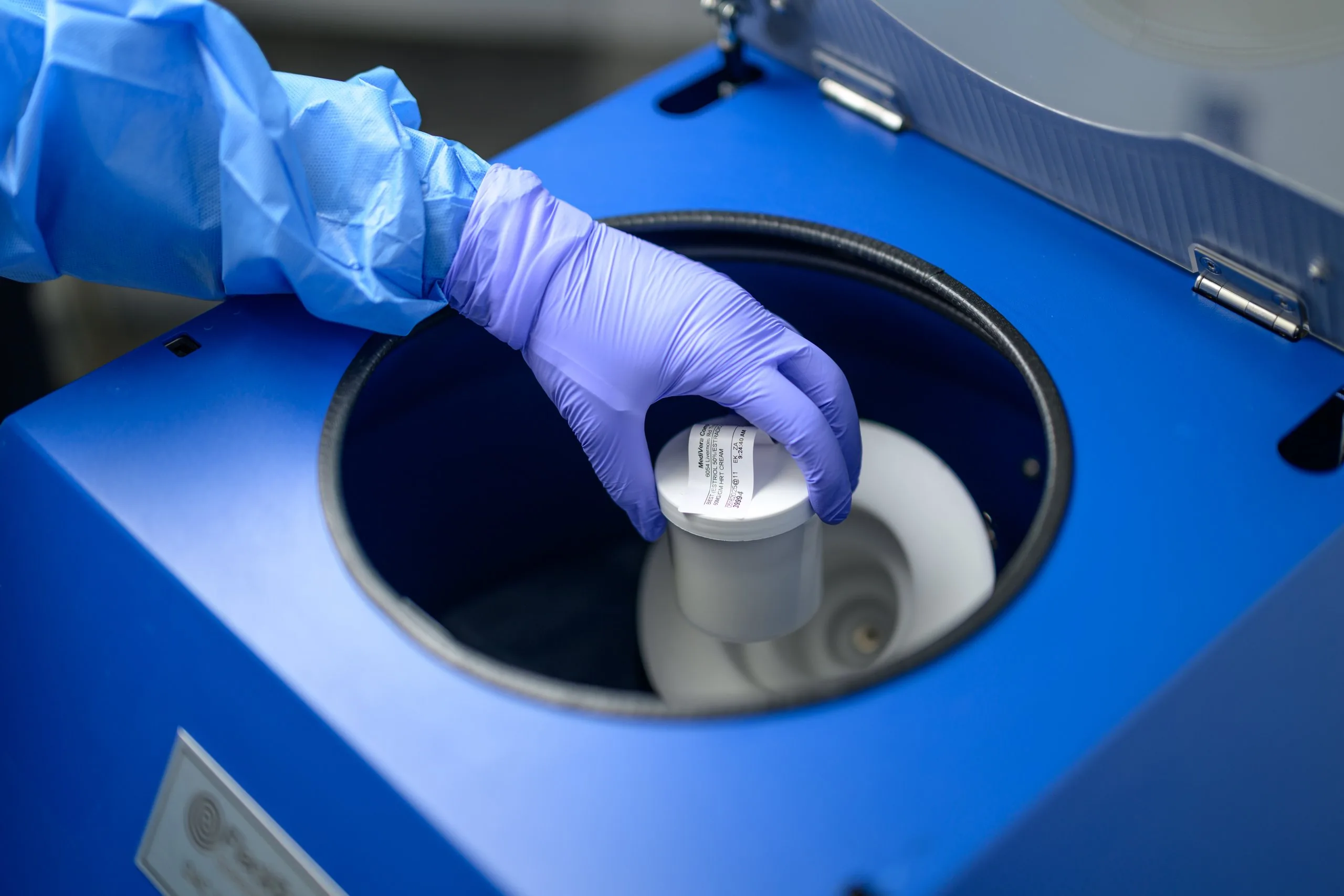
Accreditation and testing aren’t a substitute for FDA review, and they don’t make a compounded preparation FDA-approved. They are documentation your prescriber can weigh, and our quality and compliance standards set out what that testing covers. MediVera holds dual PCAB accreditation in sterile and non-sterile compounding, and invests more than $1.5M a year in third-party testing for potency and sterility.
How to Inject Trimix, and Where the Injection Goes
The 2018 AUA guideline treats the in-office injection test as a clinical principle. The first dose belongs in a clinical setting, with someone watching. What follows describes the standard technique so the appointment makes sense, not so it can be skipped.

- Select the site. Picture the shaft in cross-section as a clock face. The injection goes at roughly the 10 o’clock or 2 o’clock position, along the side, between the base and the middle third. Avoid the top midline and the underside. The main nerve bundle and the urethra sit there.
- Prepare the syringe. Wash your hands, then clean the injection site with an alcohol wipe and let it dry. Draw the ordered dose with a fine-gauge insulin syringe. Point the needle up and tap out the air bubbles until a drop appears at the tip.
- Inject. Hold the shaft firmly and insert the needle at a 90-degree angle, in to the hub. Deliver the dose slowly. Withdraw, then press a clean gauze pad on the site for a couple of minutes so it doesn’t bruise.
- Dispose safely. The used syringe goes straight into a sharps container. Never a household bin.
Two habits sit around those four steps and matter as much as the technique itself. Rotate the site every single time, because repeated injections into one spot are what drive scar tissue. Inspect the vial before you draw, and call the pharmacy instead of injecting if you see particles or a color change.
How Long Trimix Lasts, and How Your Dose Gets Set
The FDA label for injectable alprostadil tells patients to expect an erection in 5 to 20 minutes, lasting under an hour. That is the label figure, and the label covers alprostadil on its own. No equivalent figure exists for Trimix, because compounded formulas do not carry FDA labels.
Every onset window published for Trimix therefore traces back to that same alprostadil data, however confidently it is presented. Your in-office test dose is what replaces it. That number describes you rather than a study population, so it is the one worth planning around.
Your prescriber sets the dose from that same test, starting low and moving up in small steps. Most protocols take three or four office visits to settle. Too high a dose is the most common route to an erection that will not resolve.
That is why the schedule gets written down rather than left to memory. MediVera prepares Trimix in a range of strengths, so a prescriber can order the concentration that fits your protocol. We cover the mechanics of units and titration in the Trimix dosage chart and starting units.
Never change your own dose, and never borrow someone else’s.
When an Erection Lasts Longer Than Four Hours
Four hours is the line. The 2022 AUA priapism guideline defines priapism as an erection lasting past that mark. Anything that runs long but clears on its own is a prolonged erection instead, which is a different problem on a different clock.
The guideline tells clinicians to give this instruction to every patient learning injection therapy. The FDA label for injectable alprostadil says the same thing. Past four hours, you go in, and waiting it out is the wrong instinct for a reason that is anatomical rather than cautious.
During a full erection, fresh oxygenated blood stops flowing into the penis. Tissue without oxygen starts to die, and the damage accumulates while the decision is being postponed. The AUA guideline links prolonged ischemic priapism to cavernosal fibrosis, and to erectile dysfunction that does not come back.
Ask your prescriber for a written rescue plan before your first dose at home. A useful one names the hour at which you act. Then the facility, the distance, and the exact words to give the triage desk when you walk in.
Ask whether yours also specifies a medication step to take before you travel. That instruction comes from your prescriber, in writing, for you specifically. It isn’t something a pharmacy can hand out generally, and it isn’t something to improvise from an internet search.
One detail decides how fast that visit moves once you arrive. Tell the triage staff how many hours it has been, not just what happened. That number is what moves you up the queue ahead of everything else waiting in the room.
Trimix Side Effects, Scarring, and Who Injection Therapy Isn’t For
The common Trimix side effects are local and short-lived. Aching at the injection site, a small bruise, or mild swelling usually settle on their own. The risks worth planning around are the less common ones, and only some of them have published numbers behind them.
| Risk | What the data shows | Source |
|---|---|---|
| Prolonged erection (4 to 6 hours) | 4% of 1,861 patients over 18 months | Alprostadil FDA label |
| Priapism (over 6 hours) | 0.4% | Alprostadil FDA label |
| Penile fibrosis | 3% overall, rising to 7.8% in an 18-month self-injection study | Alprostadil FDA label |
| Fibrosis, plaque, and deformity across injection agents | 4.5% to 13% | AUA 2018 guideline |
Those figures need reading carefully. The label numbers describe alprostadil used on its own, and the AUA identifies it as the lowest-risk injectable agent of the group. The final row covers injection agents as a category, and no published rate exists for Trimix itself.
Treat those numbers as a floor rather than a forecast, because the combination has never been measured the same way. Fibrosis is the one that changes the long term. It is scar tissue in the erectile chambers, and enough of it produces a curve, which is Peyronie’s disease.
Left to accumulate, fibrosis can eventually make injections stop working altogether. That is exactly what rotating the injection site is meant to prevent. For the day-to-day handling of the milder effects, we go into more detail in managing side effects between doses.
Some men should not use this route at all, and the exclusions are specific rather than precautionary. The FDA label for injectable alprostadil lists the conditions where injection is contraindicated. Your prescriber screens for every one of them before writing anything.
- Known hypersensitivity to any component of the formula.
- Conditions that predispose to priapism. Sickle cell anemia and sickle cell trait both count here, as do multiple myeloma and leukemia.
- Fibrotic conditions of the penis, including anatomical deformation, angulation, cavernosal fibrosis, and Peyronie’s disease.
- A penile implant already in place.
Give your prescriber your full medication list as well, blood thinners included. One warning that gets misapplied here is the nitrate warning, which comes from how oral ED tablets work on the nitric oxide pathway. The alprostadil injection label does not carry it, and plenty of sites flatten that distinction.
The distinction matters, because injection therapy is often the option that stays open to men who cannot take oral tablets. Your prescriber makes that call with your cardiac history in front of them. The same logic applies after prostate or bladder surgery.
Oral tablets lean on nerve signaling that may not be back yet, while injections act on the tissue directly. That is why they appear in penile rehabilitation protocols during that recovery window. Timing and dosing after surgery belong to your urologist, so raise it at the appointment rather than assuming the standard protocol applies.
Storing Trimix, and Why an Injection Sometimes Does Nothing
Store compounded Trimix by the beyond-use date your compounding pharmacy assigns, and refrigeration is the usual instruction. Your prescription label carries the specifics for your batch, because compounded preparations run on the pharmacy’s dating rather than a manufacturer’s expiry. Travel takes planning around that, and storing Trimix to hold potency covers the detail.
Storage matters beyond shelf life, because it is one of the reasons an injection sometimes produces no response at all. That happens, and the answer is almost never a second injection on the same night. Four things explain most cases.
- Technique. The dose may have gone too shallow, into the wrong plane, or into scar tissue from an earlier site. Technique explains most misses in the first few months.
- The vial itself. An expired vial can lose potency, and so can one left outside its storage conditions.
- Dose. Titration usually takes three or four office visits, so an unfinished workup is a likely answer early on.
- Scarring. Existing fibrosis changes how the tissue responds.
None of those is fixed by redosing, and adding an oral tablet on top carries its own risk. Call your prescriber and describe what happened, including the site you used and the time. That detail is what lets them change something.
Answers to Common Questions About Trimix Injections
What is Trimix and what’s in it?
Alprostadil, papaverine, and phentolamine, in one injectable solution that a compounding pharmacy prepares against an individual prescription. Each of the three widens penile blood vessels by a different mechanism.
How long does a Trimix injection last?
The FDA label for injectable alprostadil sets the expectation at under an hour, with onset in 5 to 20 minutes. Trimix has no FDA label, so your in-office test dose is what establishes your own timing.
Where does the injection go?
Into the side of the shaft, at roughly the 10 o’clock or 2 o’clock position, between the base and the middle third. Avoid the top midline and the underside, where the nerve bundle and the urethra sit.
What happens if an erection lasts more than four hours?
Go to the emergency department. The 2022 AUA priapism guideline defines that as priapism and treats it as an emergency. Tissue starved of oxygen can sustain damage that leads to lasting erectile dysfunction.
Is there a way to reverse a prolonged erection?
Clinicians have medications for it, and some prescribers give patients a written rescue plan covering what to do before they reach the hospital. Ask yours for one at the next appointment, because a pharmacy can’t issue that instruction generally.
Will Trimix change penis size?
No. The drugs in the formulation act on blood flow in penile tissue. Tissue size stays the same.
Who decides the dose?
Your prescriber, working up from a low starting dose after an in-office test. Self-adjusting is the most common path to a prolonged erection, and your prescriber puts the schedule in writing for that reason.
Does it need refrigeration?
Usually yes. Check your prescription label, which carries the beyond-use date and the storage terms for your specific batch. That label beats any general rule you find online.
How often can it be used?
Your prescriber sets a maximum frequency and a minimum interval between doses, and both exist to limit scarring. We go further into how often injections can be used.
Will insurance cover it?
Often not, because compounded preparations sit outside the approval pathway most plans build their formularies around. We cover insurance coverage for compounded prescriptions separately, including what to ask your plan before you fill.
What to Bring to Your Next Appointment
Most of what makes that appointment productive is information only you can supply. Your prescriber can read a chart, but not the history you have not mentioned yet. Three things in particular make the visit go faster, and all of them are easy to bring.
- Your full medication list, including anything for blood pressure or clotting.
- Any history of penile curvature, scarring, or a blood disorder.
- A direct question about what your written rescue plan actually tells you to do at hour four.
If injection therapy is on the table, your provider can review the Trimix Solution formulation details and the available strengths. They can submit a prescription from the same page. MediVera prepares a broader range of compounded men’s health formulations your provider can review at the same time.
Sources
- Burnett AL, et al. Erectile Dysfunction: AUA Guideline. Journal of Urology, 2018.
- Bivalacqua TJ, et al. The Diagnosis and Management of Priapism: an AUA/SMSNA Guideline. American Urological Association, 2022.
- Alprostadil for injection, prescribing information. Pharmacia and Upjohn Company, via DailyMed, 2024.
- Compounding and the FDA: Questions and Answers. U.S. Food and Drug Administration, 2024.